Verify the request
Confirm authorization for the home, business or vehicle.
 EMERGENCY LOCKSMITH NEAR ME
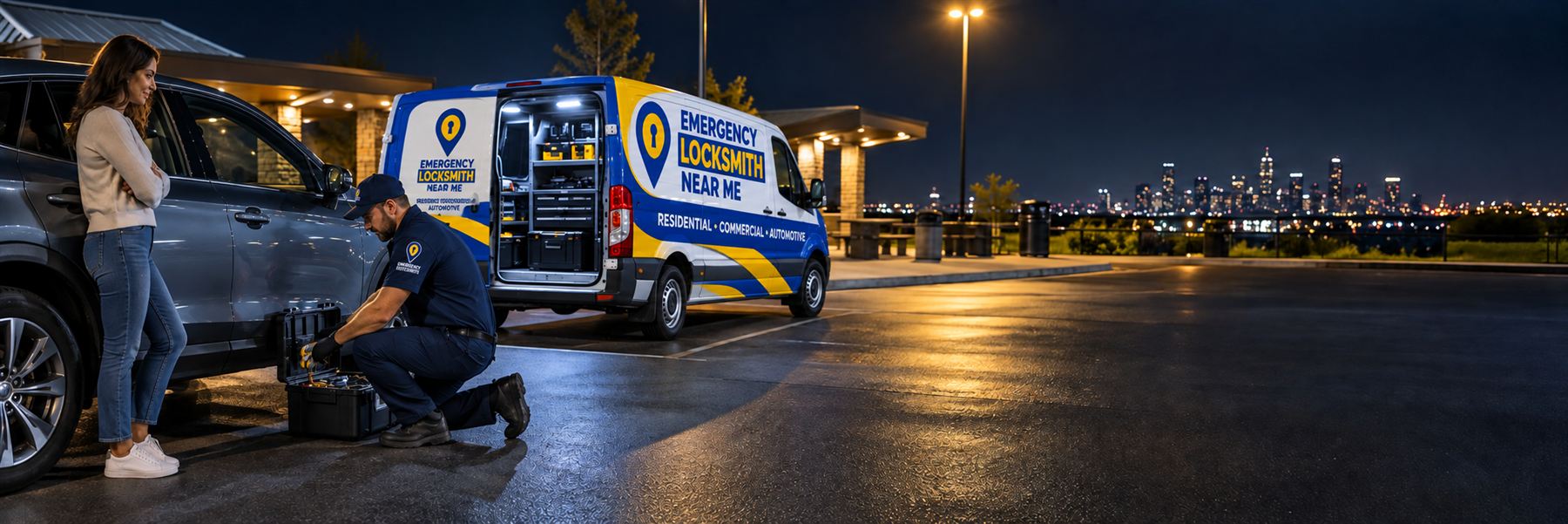
Locked out of your home, car or business? This site helps you reach an emergency locksmith in Broward, Palm Beach and parts of Miami-Dade. It explains what to do first, who can request service, what to expect on the phone and how to avoid fake listings.
Call (844) 752-1200Confirm authorization for the home, business or vehicle.
Give your location on the call so coverage can be confirmed for your address.
Quotes are given by phone and the service call charge is explained before anyone is dispatched.
A locksmith is one of the few trades that can open something someone else wants closed. That is useful when you are the person standing outside your own front door, and it is a problem when the person asking is not entitled to be inside. For that reason, a careful locksmith does not start with the lock. A careful locksmith starts with a question: who are you, and what is your right to this door, car or building?
This is not suspicion aimed at you. It protects you, too. The same checks that slow down a stranger are the checks that stop someone from opening your home, your car or your office while you are away. When a caller is asked to confirm an address, describe the property and agree to show identification on arrival, that is the system working.
South Florida adds its own wrinkles. Many homes here are condos, townhomes, rentals and seasonal properties where the person standing at the door is not the same person who holds the title. Snowbirds leave for months. Landlords manage units they do not live in. Property managers handle dozens of doors across several cities. Each of these situations raises a fair question about authority, and each has a normal, documented way to answer it.
The pages on this site are organized around that idea. The guides section covers scam prevention, quote checklists and proof of ownership. The topic hubs, including lockouts, rekeying and hardware, vehicle key problems and commercial and property management, then walk through what each situation looks like in practice.
If you only read one thing before you call anyone, read who can request a lockout service. It sets up everything else on this site.
Different people have different rights, and a good call acknowledges that early. A homeowner generally has the widest authority over a house: opening it, rekeying it, replacing hardware. A tenant has the right to enter the unit they lease, but a lease does not automatically give a tenant the right to change locks on a building the landlord owns, so a tenant asking for a rekey may need the landlord's consent first.
A property manager acts on behalf of an owner, and the paperwork that shows that relationship matters. A management agreement, a written work order from the owner, or a company account on file can all establish it. A condo or HOA board has authority over common areas such as lobby doors, mail rooms and amenity doors, but usually not over an individual owner's unit door.
For vehicles, the registered owner or a person with the owner's clear permission is the starting point. A spouse, a family member or an employee driving a company car can often be authorized, but the locksmith will want to see that the vehicle is actually yours or that the owner has agreed.
Proof of authority does not have to be complicated. The goal is to connect a real person to a real place or vehicle. For a home, that usually means a government photo identification showing the same address, or a document such as a utility bill, a lease, a mortgage statement or a tax record that links your name to the property. The proof of ownership guide and the proof of residency explainer go through the common documents in detail.
Sometimes the identification does not match the address, for example after a recent move, a new lease or a license that has not been updated. That does not end the conversation. Other paperwork can fill the gap, and a patient technician will talk through what you have rather than rushing you or refusing outright. What a reputable provider will not do is skip the step entirely because you sound upset.
For vehicles, expect to show a registration, a title or an insurance card along with your photo identification. For a business, expect to show a business license or lease, or to be vouched for by a manager whose authority can be checked. For a property manager, a letter or work order from the owner is the cleanest answer.
Keep in mind that the check often happens twice: once on the phone, when the address or vehicle details are taken down, and again in person, before any work begins. If the details you gave on the phone do not match what you can show at the door, work can stop. That is normal, and it protects the real owner.
Our what to have ready when you call page gives a short checklist you can gather in a minute or two, even while you are standing outside.
A lockout at home feels like an emergency, and sometimes it is. If a child, an infant or a person who needs help is alone inside, or if there is smoke, gas or any sign of danger, call 911 first. Emergency responders can reach people and pets in distress, and that comes before any lock question.
When nobody is in danger, the safest move is usually the calmest one. Check whether a spare key is with a trusted neighbor, a family member or a building office. Ask whether a property manager or doorman has a key on file. If you rent, your landlord or management company may be able to let you in, and that route also avoids any question about whether you are entitled to enter.
What not to do matters just as much. Do not climb balconies, force windows or work on a lock yourself. In South Florida's humid air, door hardware corrodes and swells, and forcing it can turn a simple lockout into a broken lock, a damaged frame or an injury. This site does not teach lock bypass, and it will not ask you to try anything on your own door.
A technician's job during a legitimate lockout is to confirm the caller's right to the property, assess the hardware, and choose the least destructive method that fits the situation. Sometimes that preserves the lock. Sometimes the condition of the lock makes that impossible, and the technician explains why before anything is done.
Start with the locked out of house page for the overview, then look at situations like apartment lockouts, condo lockouts and lockouts at night. If a child or pet is inside, read locked out with kids inside and locked out with a pet inside and remember the 911 rule above.
Rekeying changes the internal pins of a lock so that old keys stop working and a new key does. It is often the sensible response after a move, a breakup, a lost set of keys or a tenant leaving, because the real question is not whether you can get in. The real question is who else still can.
People tend to forget how many copies of a key exist. A previous owner, a former roommate, a contractor, a house sitter, a relative and a cleaner may all have held a copy at some point. Rekeying resets that list to the people you choose. The what is rekeying page explains the basics, and rekey versus replace helps you decide whether the existing hardware is worth keeping.
Authorization matters here as well. A rekey changes who controls a door, so the person asking needs the right to make that change. An owner can rekey a house. A tenant should confirm with the landlord first. A landlord changing locks on an occupied unit has legal obligations of their own, and nothing on this site is legal advice, so a landlord with a dispute should speak with a qualified attorney.
Higher-security options exist for people who want tighter control over copies. Restricted keyways limit who can duplicate a key, and cylinders built to resist picking and bumping raise the effort required for a casual attack. Learn more at restricted keyways and key control, high-security cylinders and master key systems.
For rentals, a clean routine at every turnover prevents a lot of trouble. See key control for landlords, rekeying after a tenant moves out and rekeying after moving in.
South Florida has an unusual number of homes that change hands, change occupants or sit empty for part of the year. That makes moving day one of the most common times for lock trouble. Keys get handed off, copies get lost, and a person standing on the porch with boxes may not be the person on the paperwork.
On move-in day, the practical question is who holds keys right now. If the previous occupant, the former owner, a real estate agent or a contractor ever had one, rekeying before you settle in is a straightforward fix. It is easier to schedule than to wonder about it later. The move-in day lockout page describes how these calls go, and new tenant lock questions to ask gives tenants a list to bring to a landlord.
On move-out day, the opposite concern applies. A tenant who has left should not still hold working keys, and a landlord preparing a unit for the next resident needs a clean handoff. Move-out day lockouts and the landlord turnover lock checklist cover the details.
Seasonal owners deal with a third pattern. A home that is closed up from late spring until the fall can have swollen doors, dead batteries in smart locks and a key that sits in a safe-deposit box in another state. Plan a lock check before you travel, leave a spare with someone who can be verified, and confirm who may authorize entry while you are away. A caretaker with no written authority may be turned away, which is the correct outcome.
Hurricane season adds one more reason to plan ahead. Doors can warp, frames can shift and keys can end up in the wrong bag during an evacuation. The locked out in hurricane season page talks through sensible preparation.
Vehicle calls have the same authorization question with different documents. A car locked at a beach lot, an airport garage or a grocery store lot is stressful, but it is still a vehicle that must be shown to belong to the caller or to someone who has agreed to the work.
A child or pet locked inside a car in South Florida heat is a true emergency. Call 911 immediately. Heat inside a closed vehicle rises quickly, and emergency responders are the right first call. Do not wait on a locksmith while someone is in distress. The child or pet locked in car page repeats this clearly because it matters.
For ordinary lockouts, the locked keys in car page explains what the technician will check and what you will be asked to show. Newer vehicles complicate things: many use transponder chips, smart keys and push-button start, and a lost or broken key may need programming rather than simple cutting. The transponder key programming explainer describes the process in plain language.
If every key is gone, read lost car keys, all keys lost. If only the remote is the problem, lost car key fob and key fob battery and replacement cover the likely answers. Some jobs can be done where the car is parked. Others need an on-site assessment or a different kind of shop, and a legitimate provider will tell you which before you commit.
Whatever the vehicle problem, keep your registration or title and your photo identification within reach. Those two items settle most authorization questions quickly.
A business lockout is not the same as a house lockout. An office, a restaurant, a medical suite or a warehouse often has several people with partial authority, an alarm system, insurance obligations and records that matter. A technician will want to know who you are within the company, whether you can authorize the work, and sometimes whether a manager or owner should confirm by phone.
Property managers carry a particular burden. They may call about a unit they have never physically visited, for a building owned by someone else. The cleanest approach is documented authority: a management agreement, an owner work order or an existing account. Our property manager lock service guide explains how to set this up before an emergency.
Condo and HOA boards have a split responsibility. Common doors such as lobbies, garages and amenity rooms belong to the association, while the individual unit door usually belongs to the owner. Mixing those up causes delays. Read HOA and condo common door locks to see how the line is normally drawn.
Larger turnovers need planning rather than a rushed call. Apartment complex turnover rekeying and master key systems for businesses cover repeating work, while business lockouts and storage facility lock issues address specific situations.
Many commercial jobs are complicated enough to require an on-site visit before any quote can be responsible. That is not a stall tactic. Exit devices, fire-rated doors and access control tie into safety requirements that cannot be judged from a phone description alone.
Lockout searches attract a particular kind of operator: a call center that lists many local-sounding names, quotes an attractively low figure on the phone, then raises the bill at the door. The pattern is widely reported, and the reasons it works are simple. A stressed person wants the problem solved and has little leverage once a stranger is standing at the door.
You can reduce the risk with a few habits. Ask for the business name when the phone is answered, and notice if it is vague or generic. Ask whether the person you are speaking with is dispatching a technician who is local to the area. Ask how the service call charge works and what happens if the job turns out to be more involved. Ask whether the technician will show identification and a company vehicle or documentation on arrival.
Watch for pressure. A reputable provider explains the process and lets you decide. A provider who insists drilling is the only option before even seeing the lock, who refuses to explain charges, or who demands payment methods that are hard to trace is giving you information about how the rest of the visit will go.
These pages go into the details: how to avoid locksmith scams, red flags on the phone, red flags on arrival, fake local listings explained and how to verify a locksmith at your door.
We also encourage you to check credentials yourself. Florida has public resources for confirming whether a business or individual is registered or permitted for certain work, and local rules differ by county and city. Verify what is claimed rather than assuming it.
Here is how a call on this site is meant to go. You describe the situation: what is locked, where you are, what kind of lock or vehicle it is, and who you are in relation to it. The person on the phone asks authorization questions and gives you a quote by phone. Quotes are given on the phone only. You will not find prices on this website, because the right figure depends on the lock, the vehicle, the location and the method.
For many jobs, a phone quote is realistic. For more complicated work, an accurate quote requires an on-site visit, and there is a service call charge for that visit. The service call charge is explained on the phone before anyone is dispatched, so that nothing about it is a surprise at the door. Read what a service call charge means and why locksmiths need an on-site visit for the reasoning.
No one on this site promises an arrival time. Distance, traffic on I-95 or the Turnpike, weather, hurricane conditions and demand all affect when a technician can reach you, and anyone who guarantees a fixed window without knowing those factors is guessing. Ask what to expect, and plan around honest information.
Sometimes a technician may recommend drilling a lock, and sometimes that is the only workable method. It should never be the first suggestion made before anyone has looked at the lock, and you should hear why. See the drill or no drill decision guide for how to think it through.
A step-by-step walkthrough lives at how a lockout call works, and the locksmith quote checklist is worth keeping on your phone. When you are ready, call the number on this page and have your questions ready.
This site covers South Florida cities across Broward and Palm Beach counties, with select areas in northern Miami-Dade. It does not cover other regions, and coverage in a given neighborhood depends on conditions at the time of your call. Ask whether your location can be served when you phone.
Housing and traffic differ across the region, and those differences change what lock calls look like. Older single-family neighborhoods in places like Fort Lauderdale and Hollywood sit alongside high-rise condos and waterfront buildings. Western Broward cities such as Pembroke Pines, Miramar, Weston and Coral Springs have many planned communities and HOAs with their own rules about doors and access.
In Palm Beach County, Boca Raton, Delray Beach, West Palm Beach, Jupiter and Wellington mix seasonal homes, gated neighborhoods, coastal condos and equestrian properties. Salt air near the ocean accelerates corrosion on exterior hardware, which is one reason door locks near the coast wear differently than those inland.
In the southern part of the area, Aventura, North Miami Beach and Miami Gardens bring dense condo towers, managed buildings and a high share of renters, so authorization with building management is often part of the call.
The full list is on the service areas hub. Browse the pages for your city to see the housing types and typical situations there. Whichever city you are in, the principle is the same: confirm who you are, show what proves it, understand the charge before dispatch, and call when you are ready.
Usually the owner, or a tenant with a current lease for the unit they live in. A landlord or property manager can request work when documents connect them to the property. Anyone acting for someone else should expect to show a written permission or work order. The exact proof depends on the situation, and the technician will ask before starting any work.
Typically a government photo identification plus something that links you to the property or vehicle, such as a lease, a utility bill, a mortgage statement, a registration or a title. If your identification shows an old address, other paperwork can often fill the gap. Having these items ready before you call usually makes the visit smoother.
No. Quotes are given by phone only, because the right figure depends on the lock, the vehicle, the location and the method required. More complicated jobs need an on-site visit. There is a service call charge for that visit, and it is explained on the phone before a technician is dispatched, so nothing about it is a surprise.
No. Arrival depends on distance, traffic, weather, demand and the technician's current work, so no honest provider can promise a fixed window in advance. Ask the person on the phone what to expect for your location at that moment. If a child, a pet or a person in distress is locked in, call 911 first.
No. This site does not provide lock bypass or lock picking instructions, because the same information could be used against someone else's property. Safer options are to check for a spare key, contact a landlord or building office, or call a locksmith who will confirm your authorization before starting work.
Ask why, and ask whether non-destructive methods were considered after the technician examined the lock. Drilling is sometimes the only workable option, for instance with a damaged or high-security cylinder, but it should be explained and agreed to before it begins. The drill or no drill guide on this site walks through the questions to ask.
If "Locksmith Help That Starts With Who Is Allowed to Ask" matches your situation, a phone call is the simplest way to see how the job would work. Quotes are given by phone, and a job that needs eyes on the lock gets a technician visit.
Service areas across Broward, Palm Beach and parts of Miami-Dade, South Florida. Coverage for your exact address is confirmed on the phone.